
A few years ago, a parent called me in a panic:
"Andrew is absolutely devastated after being deferred from Columbia. What do we do now?"
I understood her worry. Getting deferred from your dream school can feel devastating. You worked for months on applications and spent nights imagining yourself walking around lush green campuses and hanging out in the student center. You were supposed to be done. Now you have to wait, stuck in limbo, wondering if you still have a chance.

Andrew felt the same way. But after writing a strong LOCI and executing a strategic plan, he was eventually admitted to Columbia.
You’re not alone in this experience. As early applications have grown, so has the number of students being deferred from college. Every year, colleges defer 70-80% of early decision and early action applicants. Make sure you check out the post Deferred from College? Here’s What to Do Next (2025-2026 Guide) for how to respond strategically to increase your chances.
This post gets tactical. We’ll walk step-by-step through how to write a LOCI—one of the most powerful tools you have to tip the scales in your favor. A well-crafted Letter of Continued Interest can genuinely add value to your application, make you a stronger candidate, and most importantly, ensure you’re still in the running. But this is only true if it’s strategic, specific, and timely. Keep reading to learn exactly how to write a strong LOCI that works.
Table of Contents

Quick Snapshot: What You Need to Know Right Now
What is a deferral?
Your student’s application is postponed to Regular Decision. They’re still in consideration. This is not a rejection.
How common are deferrals?
At highly selective colleges, 30–80% of early applicants are deferred. At schools like Harvard and MIT, 70–80% of early applicants are deferred.
What are the chances after deferral?
Ivy+ schools: 2–8% of deferred students eventually admitted
Top 20 privates: 5–15% of deferred students eventually admitted
Top 50 schools: 10–25% of deferred students eventually admitted
Does strategy actually matter?
Yes—significantly. Students admitted after deferral almost always take strategic action. Students who wait quietly almost never get in.
What should you do first?
Read your student’s deferral letter carefully, meet with their counselor within one week, and start planning their Letter of Continued Interest (LOCI).
⬇️ Keep reading for the complete breakdown of statistics, what they mean, and your action plan.
Chart 1: Chances After Deferral by Selectivity Tier
Higher bar = higher typical admit rate from deferral pool
Your student was deferred. Now you’re googling at midnight, trying to figure out what this actually means for their chances.
Not the platitudes. The reality.
Let’s start with this: a deferral is not a denial. But it is also not a waiting room where nothing happens.
This post walks through college deferral statistics for 2025, what they tell us, and how families should interpret them without panic or false hope.
How Common Are College Deferrals in 2025?
Deferrals are more common than most families realize, especially at selective colleges.
Over the past several admissions cycles, colleges have increasingly used deferral as a way to manage enrollment uncertainty, reevaluate students in the context of the Regular Decision pool, and preserve flexibility in shaping the final class.
At many Top 50 colleges, 30–60% of Early Action or Early Decision applicants are deferred. At the most selective schools, the percentage can be even higher.

From an admissions standpoint, a deferral often means:
“You’re academically qualified, but we need more context before making a final decision.”
That context comes from two places:
- the rest of the applicant pool, and
- what your student does after being deferred.
Does a Deferral Mean Rejection?
No. But it also does not mean your student is “basically in.”
A deferral means the admissions office saw enough strength to keep the application alive, but not enough clarity to say yes yet. Your student is still competitive, but no longer evaluated in isolation. They are now compared directly against strong Regular Decision applicants, other deferred students, and institutional priorities that may shift between December and March.
The key takeaway: deferred students who are later admitted almost always strengthen or clarify their application in some way. Waiting quietly is rarely the winning move.
What Successful Deferred Students Do Differently
Here’s what I’ve observed across hundreds of applications: students with a clear strategy don’t always get in. But students without one almost never do.
Students admitted after deferral typically do three things well:
- They provide meaningful academic updates (stronger grades, continued rigor, new coursework that supports readiness).
- They clarify academic direction with specificity (why this major, why this program, why now).
- They submit a strong, well-timed LOCI that adds new information, reinforces fit, and sounds engaged (not desperate).
They also avoid over-communicating: no generic updates, no flooding admissions with extras the school didn’t request.
College Deferral Acceptance Rates: What the Numbers Actually Show
Colleges are not required to publish deferral admit rates, and many don’t. When they do, the numbers can feel sobering without proper context.
Below are the numbers as a way to think, not a promise of outcome.
Chart 2: Tier 1 "Reality Check"
How to read: "Deferred" shows the share of early applicants pushed to RD. "Admit from deferral pool" shows the share of those deferred students who are later admitted.
Tier 1: Ivy+ / Ultra-Selective
Tier 2: Top 20 Privates
Tier 3: Top 50 Selectives
Tier 1: Ivy+ and Ultra-Selective Universities
- Deferral range: 40–78% of early applicants
- Eventual acceptance from deferral: 2–8% typically
- Generic LOCIs accomplish nothing — and in some cases quietly hurt
| University | Early Apps (2024) | Early Deferral Rate | Admitted from Deferral Pool | Early Admit Rate | Overall Admit Rate |
|---|---|---|---|---|---|
| Harvard | 9,553 (REA) | 78% | ~10% of deferred (2–3% overall) |
7.6% | 3.2% |
| Yale | 7,856 (SCEA) | 52% | ~6–8% of deferred | 10% | 3.7% |
| Princeton | 6,743 (SCEA) | 50–55% | ~5–8% of deferred | 13% | 3.9% |
| Stanford | 10,411 (REA) | 60–65% | ~3–5% of deferred* | 9.7% | 3.0% |
| MIT | 12,563 (EA) | 64% | ~5% of deferred | 5.7% | 4.0% |
| Columbia | ~6,000 (ED) | 40–45% | ~6–10% of deferred | 12% | 3.9% |
| Penn | 8,500 (ED) | 30–35% | ~8–12% of deferred | 15% | 5.1% |
| Brown | 6,770 (ED) | 45–50% | ~5–10% of deferred | 13% | 4.8% |
| Dartmouth | 3,592 (ED) | 40–45% | ~8–12% of deferred | 16% | 5.6% |
| Cornell | 9,000+ (ED) | 25–30% | ~15–20% of deferred | 19% | 7.3% |
| Caltech | 1,816 (EA) | 45–50% | ~5–8% of deferred | 10.4% | 2.7% |
| UChicago | ~15,000 (ED/EA) | 60–70% | ~7–12% of deferred | 13% | 4.7% |
Abbreviations:
- REA = Restrictive Early Action (non-binding, but restricts where else you can apply early)
- SCEA = Single-Choice Early Action (non-binding, cannot apply EA elsewhere)
- EA = Early Action (non-binding)
- ED = Early Decision (binding)
- *Stanford explicitly discourages additional materials after deferral
Tier 2: Top 20 Private Universities
- Deferral range: 30–50% typically
- Georgetown is an outlier at 85% due to its EA structure
- Eventual acceptance from deferral: 5–15% depending on year
- Strategy matters significantly here
| University | Early Apps (2024) | Early Deferral Rate | Admitted from Deferral Pool | Early Admit Rate | Overall Admit Rate |
|---|---|---|---|---|---|
| Duke | 6,240 (ED) | 40–45% | ~8–12% of deferred | 16% | 4.8% |
| Northwestern | 6,425 (ED) | 35–40% | ~10–15% of deferred | 20% | 7.0% |
| Vanderbilt | 6,195 (ED) | 30–35% | ~12–18% of deferred | 19% | 5.8% |
| Rice | 3,164 (ED) | 35–40% | ~10–15% of deferred | 17% | 7.6% |
| Johns Hopkins | 3,600 (ED) | 35–40% | ~10–15% of deferred | 15% | 6.1% |
| Notre Dame | 11,377 (REA) | 45–50% | ~8–12% of deferred | 13% | 11% |
| Georgetown | 9,250+ (EA) | 85% | ~10–12% of deferred | 11% | 10% |
| Emory | 5,800 (ED) | 30–35% | ~12–18% of deferred | 22% | 11% |
| Carnegie Mellon | 4,900 (ED) | 35–40% | ~10–15% of deferred | 16% | 11% |
| USC | 12,000+ (Various) | 30–35% | ~10–15% of deferred | Varies | 9.9% |
| NYU | 10,000+ (ED) | 25–30% | ~15–20% of deferred | 23% | 8% |
| Tufts | 4,100 (ED) | 35–40% | ~12–18% of deferred | 22% | 9.7% |
What This Tier Shows:
At this level, colleges are more transparent about using deferral as a genuine second look. Students who succeed post-deferral often update grades and rigor, add meaningful achievements or recognition, and show clear interest aligned with specific programs or values.
Abbreviations:
- REA = Restrictive Early Action (non-binding, but restricts where else you can apply early)
- EA = Early Action (non-binding)
- ED = Early Decision (binding)
Tier 3: Top 50 Selective Public and Private Universities
- Deferral range: 20–40% of early applicants
- Eventual acceptance from deferral: 10–25%
- Used to balance enrollment and assess in-state vs. out-of-state priorities
- Well-executed follow-up materials can meaningfully impact outcomes
- Note: UC system does not offer early decision/early action
| University | Early Apps (2024) | Early Deferral Rate | Admitted from Deferral Pool | Early Admit Rate | Overall Admit Rate |
|---|---|---|---|---|---|
| UVA | 17,500+ (EA) | 40–45% | ~15–20% of deferred | 19% (in-state) | 18% overall |
| UNC Chapel Hill | 31,000+ (EA) | 45–50% | ~12–18% of deferred | 23% (in-state) | 16% overall |
| UMichigan | 11,000+ (EA) | 50–60% | ~10–15% of deferred | 41% (in-state), 19% (OOS) | 18% overall |
| Boston College | 5,200 (ED) | 35–40% | ~15–20% of deferred | 26% | 15% |
| William & Mary | 7,800 (ED/EA) | 35–40% | ~18–25% of deferred | 34% (ED), 30% (in-state EA) | 33% overall |
| Georgia Tech | 20,000+ (EA) | 30–35% | ~15–20% of deferred | 46% (in-state), 17% (OOS) | 16% overall |
| Tulane | 8,500 (ED/EA) | 25–30% | ~15–25% of deferred | 18% (ED), 12% (EA) | 11% |
| Wake Forest | 3,800 (ED) | 30–35% | ~18–25% of deferred | 37% | 21% |
| Villanova | 4,200 (ED/EA) | 25–30% | ~20–28% of deferred | 31% (ED) | 23% |
| UT Austin | 30,000+ (Various) | 20–25% | ~18–25% of deferred | Varies greatly | 29% overall |
| UC Berkeley | UC system does not offer early admissions | 11% | |||
| UCLA | UC system does not offer early admissions | 9% | |||
What This Tier Shows:
At these schools, deferral is often used to balance enrollment, reassess students relative to in-state or institutional priorities, and gauge demonstrated interest. Well-executed follow-up materials can meaningfully impact outcomes here. Note the significant difference between in-state and out-of-state admission rates at public universities.
Important Notes:
- OOS = Out-of-state applicants
- EA = Early Action (non-binding)
- ED = Early Decision (binding)
- UC System: Berkeley and UCLA (along with all UC schools) use a single application deadline and do not offer early decision or early action programs, so deferral statistics do not apply
- At public universities, in-state vs. out-of-state status significantly impacts both early and overall admission rates
Why Deferral Statistics Alone Don’t Tell the Whole Story
While it’s tempting to fixate on percentages, the data doesn’t show the real differentiator: what admitted deferred students did next.
Admissions officers aren’t only asking, “Is this student strong enough?” They’re asking:
“What has changed or become clearer since December?”

Common Deferral Mistakes That Hurt Chances
Deferrals create anxiety, and anxiety leads to mistakes.
The most common: sending a rushed or emotional LOCI that restates the original application without adding value. Your LOCI needs to add something new, not repeat what admissions already knows.
Another: assuming silence is safer than action. Failing to submit any meaningful update is one of the biggest mistakes families make.
Also: flooding admissions offices with extra materials the school did not request. More emails and more documents rarely help, and sometimes hurt.
Finally: treating all deferred schools the same. Each institution has different policies and priorities. Tailor your follow-up accordingly.
Is Strategy Really Necessary to Get Off the Deferral List?
Yes—because deferral is an evaluation phase. Admissions officers are still building a class. They are still comparing students. They are still looking for reasons to say yes.
A thoughtful strategy helps ensure that your student’s strongest angles are reinforced, new information is presented clearly and appropriately, and the application evolves rather than stagnates.
Strategy does not guarantee admission. But students without a strategy almost never get in.
One Important Caveat
Even with perfect execution, most deferred students don’t get admitted. That’s not pessimism. It’s math.
But strategy isn’t about guarantees. It’s about making sure that if your student doesn’t get in, it won’t be because you missed something obvious in December.
What to Do Next If Your Student Was Deferred
The weeks following a deferral matter more than most families realize. This is not the time for panic, but it is the time for structure.

At a minimum, families should understand each school’s deferral policies and timelines, decide whether and when to submit a LOCI, identify what meaningful updates can be shared, and avoid actions that could undermine the application.
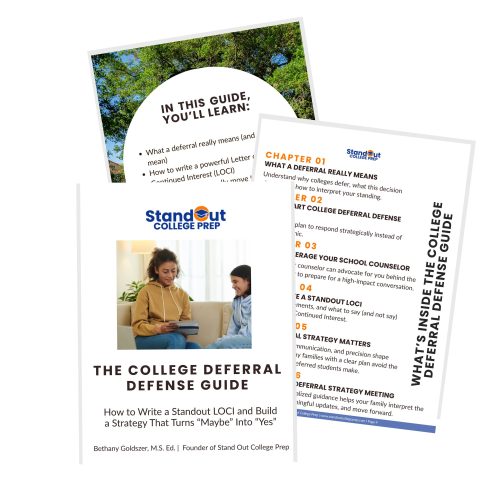
Get the Complete Roadmap
If you want a step-by-step plan that walks through exactly how to handle a deferral, including LOCI guidance and timelines, start here:
College Deferral Defense Guide
A step-by-step framework covering:
Exactly when and how to send a LOCI (with 3 complete examples)
Which updates matter and which don’t
Month-by-month timeline from December through April
What not to do (mistakes that actively hurt)
Download the College Deferral Defense Guide to get started today.
Need Personalized Guidance?
Is a Strategy Meeting right for your family? It makes sense if your student was deferred from multiple highly selective schools, you’re unsure which schools warrant follow-up, or your family needs help prioritizing limited time effectively.
In one session, we’ll map out which schools to focus on, what updates to send, and when.
Book a 1-Hour Deferral Strategy Meeting, and we’ll create a clear, confident plan together. No pressure, no sales pitch—just strategic support when you need it most.
Final Reassurance
A deferral is emotionally draining. It comes after months or years of hard work, right when families are already exhausted.
But deferral statistics for 2025 tell us something important: many students who are deferred are still very much in the running.
The difference between those who are admitted and those who are not is rarely luck alone. It’s clarity. It’s timing. And it’s having a plan.
What to do right now (before you close this tab):
Download the Defense Guide if you need the full roadmap
Book a Strategy Meeting if your student was deferred from multiple reaches or needs personalized guidance
Or simply breathe. You have time. But use it.